Located in the south of France, it is one of the most beautiful spots in the country where you can practice this sport, with options to suit all tastes and periods of the year.
In this article you will find interesting and (we hope) super useful information to prepare your climbing trip in the mythical Gorges du Tarn, de la Jonte and de la Dourbie.
To satisfy your curiosity as to why a visit to this paradise is worthwhile, we have described the geography surrounding these gorges, the characteristics of the rock and the best season to climb.
To help you choose the spot that best suits your needs and possibilities (and those of your climbing partners of course!) we’ll tell you a bit about the sectors and the climbing. And a super tip for communicating with the locals 😉
And as there are other important human needs besides climbing, we give you information about where to sleep and eat, and other activities.
Enjoy your reading!
The journey to discover these gorges begins slowly, as if the walls wanted us to take the time to prepare our body and mind before the first encounter.
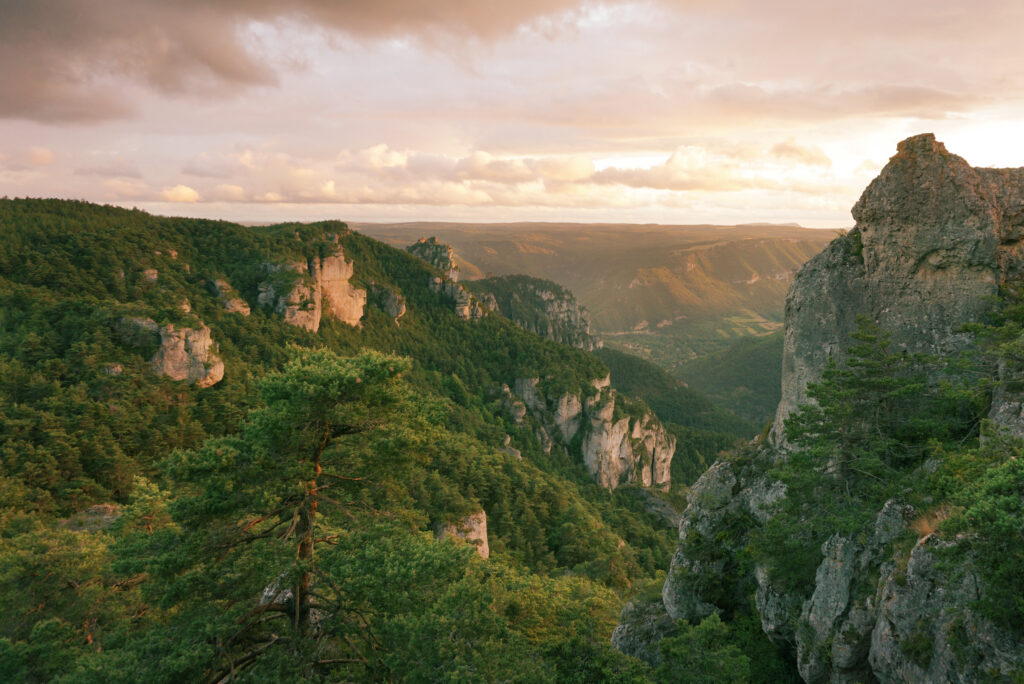
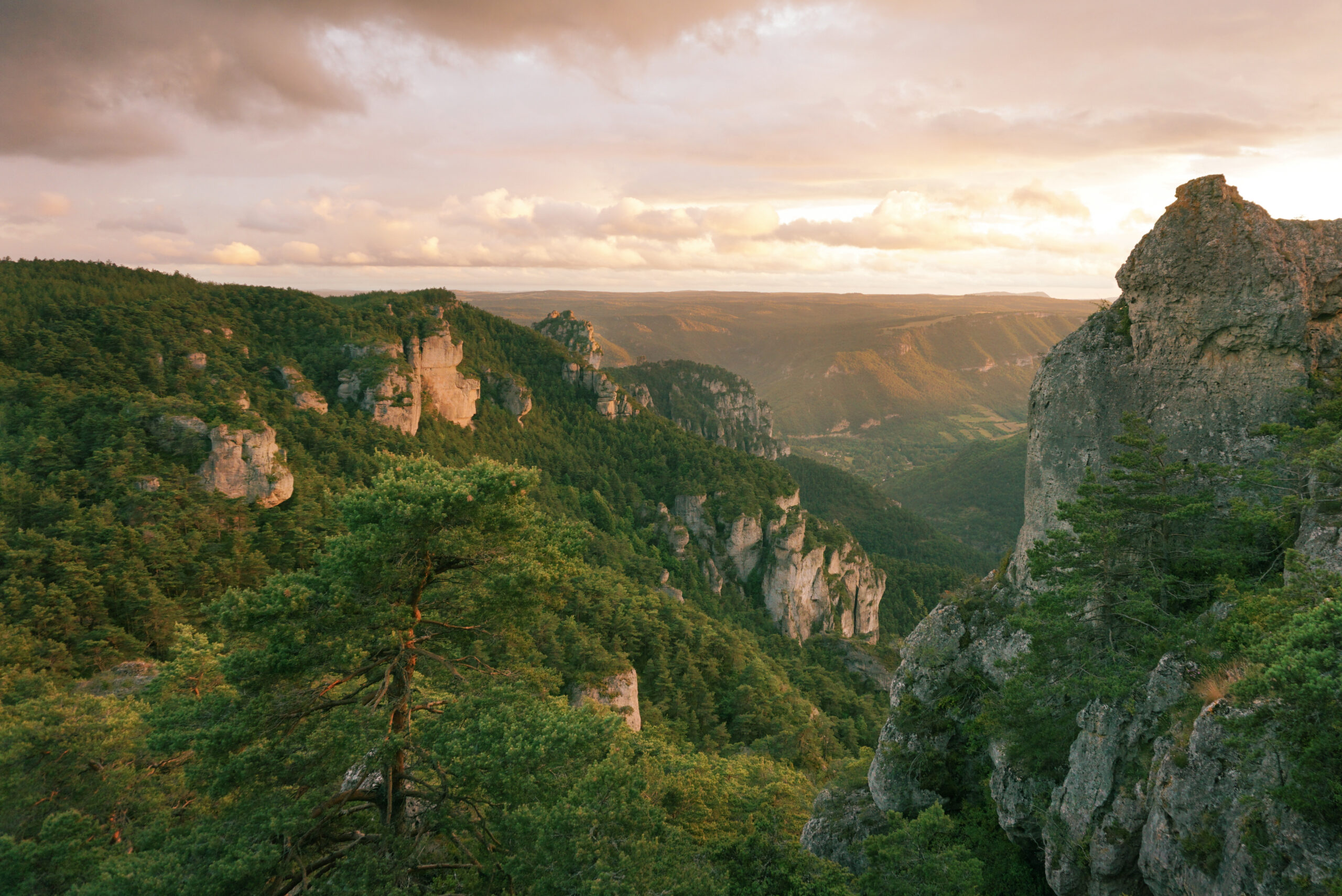
They are reached through a winding path that meanders along the river and gradually enters the forest that protects them. When we finally have them in front of us, the first impression is always unforgettable… almost as if we needed bigger eyes to admire so much beauty. The walls reach as far as the eye can see; with the white-grey-orange tones characteristic of dolomite decorated with the blues and violets of the traces of manganese, with a porosity that gives them a perfect texture, with all the possible shapes and spaces that make climbing in this place a delight for all the senses…
GEOGRAPHICAL CONTEXT
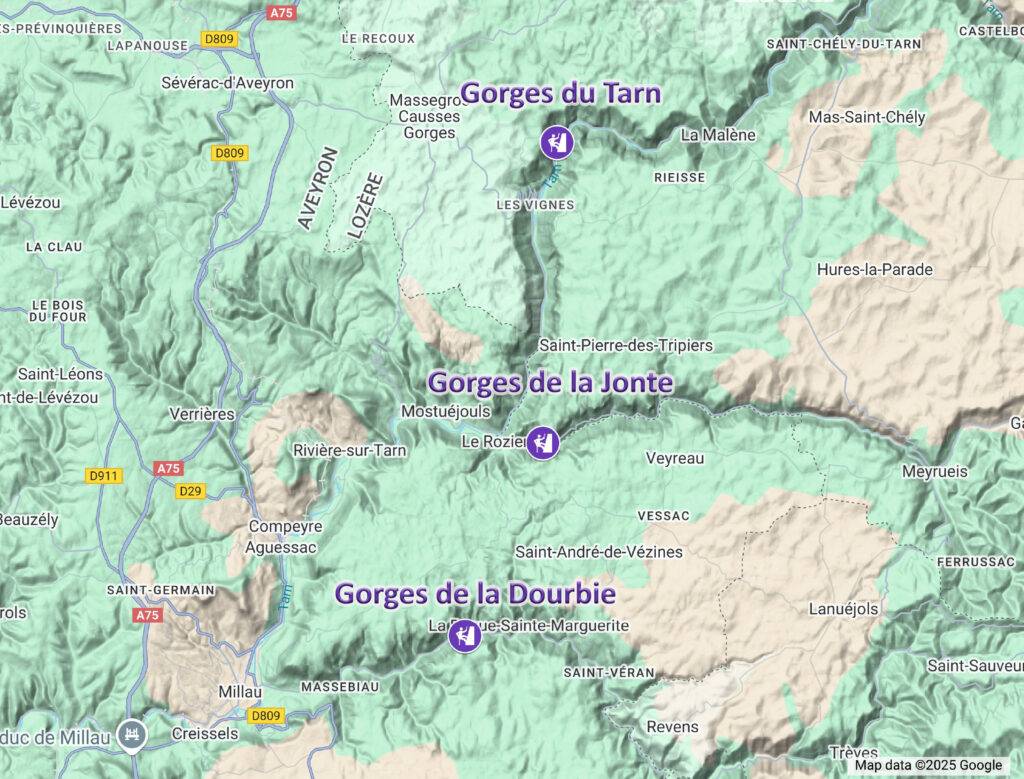
They are located in the centre-south of France, within the departments of Aveyron and Lozère, which has the particularity of being the least populated department of France, but compensates this lack of inhabitants with an excess of nature (good deal right?). The natural beauty surrounding the gorges is protected by two large areas: Parc naturel régional des Grands Causses and Parc national des Cévennes.
These are three different rivers whose gorges represent three clearly identified climbing sectors, the Tarn being the main river and the Jonte and the Dourbie tributaries of it. And around these gorges are the Causses, which are limestone plateaux that rise to an average altitude of 900-1000 m.a.s.l. and are bounded by these gorges. The most important in the area are the Méjean, the Sauveterre, the Noir and the Larzac; and there are also other secondary Causses.
TYPE OF ROCK
The ‘nerd’ fact that helps to understand the beauty of this rock, is that we’re talking about dolomite. It belongs to the group of carbonate rocks but in its composition part of the calcium carbonate has been replaced by calcium and magnesium carbonate. Over the centuries, water has moulded the walls, giving them a very characteristic morphology, which is why the climbing styles can be so varied:
- Some walls are very vertical; when we look at them from below we may think: ‘But where are the holds? and then as we climb them, we discover the small holes, the crimps, and the tiny feet that allow us to enjoy a more technical climbing.
- There are other walls with large overhangs full of jugs to satisfy the needs of those who prefer a more physical and powerful climbing.
- There are cracks, some of which are very long and have created some ‘mythical’ routes, there are dihedrals, there are roofs, ledges, traverses, chimneys, spires, edges, there are caves! Long story short… we have everything we need to be happy climbing 😁
SEASONS AND WEATHER
With three different gorges, about 20 sectors (and many more sub-sectors), and approximately 2000 routes, we could say that here we can climb all year round (or almost…). Perhaps the period to avoid is in mid-autumn, from mid-October to the end of November, which is when it usually rains a lot in the area. It can also occur in spring, from April to the beginning of May, but at this time it is more variable.
- WINTER: Between November and February temperatures can be very cold, but on sunny days it is possible to climb in south exposed crags. Most of them are in the Jonte and Dourbie gorges.
- AUTUMN AND SPRING: These are the ideal seasons for climbing, and here you can practically climb in the three gorges, choosing the right time.
- SUMMER: It is very difficult to climb in the south exposed sectors, unless you are one of those super-motivated-sporty climbers who likes to set the alarm at 6am. Otherwise for the summer, the Tarn gorges are the best option. There are many crags with an eastern exposure, which go into the shade around 14:00. And for the very hot days, it is enough to go for a dip in the cool waters of the Tarn or the Dourbie rivers (between 15-18°C) before the climb, after, or why not both options.
HOW TO COMMUNICATE WITH LOCALS?
If you’ve ever climbed in France, you may have experienced difficulties communicating with local people. We know that French people are very affectionate to their own language and therefore less inclined to communicate in other languages… 😝 To bridge this gap, having a copy of blablaCLIMB in your backpack could help you connect with the locals, ask questions about how to get to that hidden sector or get advice on the best way to overcome the crux of that project that’s keeping you awake at night.
ABOUT THE SECTORS (GEAR NEEDED AND APPROACHES)
In general terms, two of the gorges are mostly single-pitch routes (Tarn and Dourbie) and one is mainly multi-pitch (Jonte). However, there are exceptions in both cases, i.e. there are single-pitch sectors in the Jonte gorges, and multi-pitch routes in the Tarn and the Dourbie gorges.
For the single-pitch routes, with a rope of 80 meters we could climb a good part of them, but there are some exceptions of routes that are 50 meters or longer. In these cases, we can choose a 100 meters rope, or make the descent in several stages (normally routes longer than 40 meters have 2 or more anchors). Always check the knot at the end of the rope.
The number of quickdraws will vary depending on the length of the route, but as a general rule 15 are enough to do the first pitch, and up to 25 if you want to try the complete routes.
The approaches are very variable but in general in the Tarn gorges they tend to be short, from non-existent to 10 minutes maximum, with some exceptions of up to half an hour. In the Dourbie gorges there are three main sectors, Boffi with an approach of 35-40 minutes, Laumet of less than 10 minutes, and in Cantobre it varies according to the sector, but they are mostly short (15 minutes approx.).
Multi-pitches are routes of ‘few’ pitches, 4 or 5 on average and up to 7, which allows us to complete two or more in a day if we are motivated. Most of the routes run between 100-120 metres, with a maximum of 150 metres (including the horizontal development). For the rappels, a 60 metre double rope gives us access to everything, and a set of 15 quickdraws. The approaches are a bit longer in the Jonte gorges, you have to walk for 15-20 minutes for most of the routes, with some exceptions of up to 30 minutes.
ABOUT THE CLIMBING (CHOOSING OUR SECTOR)
As we said before, the climbing in these three gorges is very variable and there are options to suit all tastes, adapting to our group and available time. For the single-pitch routes:
- All grades, short approach: There are sectors ideal for mixed groups (i.e. people who climb 4 and people who climb 7 or more) and easy access, such as ‘La muse’, ‘Foetus’, ‘Des que fas aqui’ in the Tarn gorges, or ‘Laumet’ in the Dourbie gorges. Logically, due to their characteristics of being accessible and complete, they tend to be very popular.
- All grades, medium/long approach: For mixed groups who prefer to gain in solitude by walking a little more, the best sectors are ‘Little brothers’ in the Tarn gorges, ‘Le révérend’ in the Jonte, or ‘Le boffi’ in the Dourbie gorges.
- Sixth grade: For those who climb comfortably within the sixth grade, ‘Noir désir’, ‘Vallon/Trésor du zebre’ or ‘Club house’ in the Tarn gorges, or ‘La vénus de Millau’ and ‘Les couennes a didos’ in the Jonte gorges. .
- Grade 7 and above: For those who climb 7 and above, the Tarn gorges have a lot to offer. All the sectors of the Cirque des Baumes and Baumes Hautes (in particular the ‘Oasif’ sector) are noted for their beauty.
Within the multi-pitches there are also routes for all levels. Note that all multi-pitch routes require at least a 15-minute walk.
- Tarn gorges: The options are few but excellent, such as the Roc Aiguille arete, where there are two very beautiful routes for beginners (‘Iseki’ and ‘Youna’), or the wonderful ‘Sublime faiblesse’ in the ‘Fadarelles’ sector, more suitable for those who climb comfortably in 6.
- Jonte gorges, for beginners: For those climbing at 4-5 grades there are some great classic routes. For example ‘Le révérend’, ‘Pégase’, ‘Zébulon’, ‘Le bitard’, or ‘Le jardin enchanté’.
- Jonte gorges, from grade 6 upwards: Some of the classics are ‘Les femmes et les grimpeurs d’abord’, ‘Biotone’, ‘L’arete ouest’ or ‘La diagonale du gogol’. For those who climb in 7 and more, the options multiply…
SPECIAL MENTION: RUNOUTS
Climbing in this area, in the Jonte and the Tarn gorges in particular, has become famous for having routes bolted with runouts, which we believe is a rather subjective concept and depends on one’s own perception and experience. Normally in grades 4-5 the routes are amply bolted, with runouts starting from grade 6 onwards, but mainly on sections where the moves are not so difficult. As a general rule, the bolts tend to be closer at the beginning of the route and as we climb they get further away, but we almost always have a good hold for clipping, and when we have to climb 2 metres or more till the next bolt, they tend to be accessible sections. This is especially valid for the Tarn gorges.
On the multi-pitches in the Jonte gorges it is more common to find runouts of 3 metres or more, but it is the same principle, they are accessible sections of the routes.
So, get ready to improve your mental skills and come and discover this climbing paradise, you won’t regret it 💪
**BONUS-CLIMB** BOULDERING AND DEEP WATER SOLOING
As if we hadn’t said it enough… the climbing possibilities in this corner of France are INFINITE!!!! If you are interested in these variants of climbing, the Alpine Club OUEST CAUSSE has published a small guide with some sectors in the Jonte gorges where you can practise bouldering and deep water soloing; an excellent idea to refresh on the hottest days. You find it in the same shop in the village of Le Rozier where the other guides are available.
ACCOMMODATION/SERVICES
The choice of the place to stay will depend on where you want to climb.
- Dourbie gorges: the most comfortable option is the town of Millau. There is a wide range of campsites and other types of accommodation for those who want more comfort, and all the services nearby. From the campsites in Millau it is a 10-minute drive to the first sector in Dourbie gorges, and the other gorges are not so far away either. You get to the Jonte gorges in 25 minutes, and for the first sectors of the Tarn gorges in about 40 minutes.
- Jonte gorges: the ideal place is the small village of Le Rozier, from where we are less than 5 minutes by car from the first crags. Here you will find many camping options, and some hotels or private accommodation. During the tourist season (from June to mid-September) there is a small supermarket where you can buy some food and drinks, and a wide range of bars and restaurants. From here it is a 10-minute walk to the first sector of the Tarn gorges, and a 20-minute drive to the beginning of the others.
- Tarn Gorges: the most convenient is the small village of Les Vignes, with campsites, hotels and a small supermarket. From here you can walk to the first sector, or drive a few minutes to the next ones.
To buy the climbing guides (oh yes… guides in plural, each gorge has its own) the most convenient option is the tobacco shop in the little village of Le Rozier, or the Millau tourist office. The price is 22 euros at the publication date of this article (October 2024).
OTHER ACTIVITIES
If you are one of those people who like to do different activities in addition to climbing, as long as you like nature and outdoors, this is the perfect place!
The offer is very wide and varied, also adapted to all tastes and budgets: paragliding or hang-gliding, bungee jumping, caving, canyoning, via ferrata, slackline, mountain biking, hiking, kayaking in the rivers…
In addition, there are some viewpoints that will give you the possibility to admire the wonder of this landscape from another perspective, such as Point Sublime or Roc des Hourtous.
Or visit some of the charming little villages in the gorges, like Saint Chely du Tarn, La Malène, Sainte Enimie, Quézac (Tarn gorges), Meyrueis in the Jonte gorges, Cantobre and Nant in the Dourbie gorges.
A visit to any of the Causses is an adventure in itself, taking you to a completely different environment, wide open, with views that fade into the horizon and buildings that seem to come from remote times.
And in the summer months the villages are animated by festivals, parties, markets, and many gastronomic options to have some fun after an intense day of climbing.



 City
City
 300 m.a.s.l.
 Bus
Bus
 Car
Car
 Hotel
Hotel
 Private lodging
 Camping
 Supermarket
 Market
 Eating places
 ATM
ATM
 Hiking
 Trekking
 Snow
Snow
 Water
Water
 Nature parks
 Museums
 Spring
 Summer
 Autumn
 Climbing wall/Climbing spot
 Climbing days/Courses

 Trad
Trad  Multi-pitch
 Town
Town
 Wild camping


 Gear rent


 Climbing area


 Bouldering
 Ice climbing
 Big wall

 Plane
Plane